
A device protection plan is easy to sell and hard to run.
Collecting a premium is the simple part. The difficulty is everything after: who is actually covered right now, who qualified for a waiver, whose coverage lapsed because the premium never arrived, and whether this claim is their first or their fourth. Get any of those wrong and the program either loses money or loses trust.
Where it breaks today
A deductible field in a spreadsheet is not an insurance program.
Most districts start with a flat fee and a column marked covered. It survives until the first real edge case, which arrives in about October: a family who paid late, a student who qualified for a waiver after enrolling, a second claim on the same device, a repair that costs more than the plan was ever meant to absorb. Each one gets handled by judgment, the judgments are not written down, and by spring no two families have been treated the same way.
- Nobody can say with certainty who is covered today, only who paid at some point
- A premium goes unpaid and the coverage quietly stays active anyway, so the district absorbs a repair it was never paid for
- Free and reduced families get billed and then refunded, or get missed entirely because somebody had to remember
- A second or third claim on the same plan is approved because no one is counting
- Two families with identical damage are charged different amounts, and neither can be told why
The workflow
How it actually runs.
- 1Step 1 of 6
Coverage is defined with the variables that actually matter
A single deductible number cannot express a real plan. Four variables can: the co-pay a family owes regardless of repair cost, the percentage of the cost the policy absorbs, the ceiling on what it will absorb for any one incident, and how many times the plan can be claimed in a term. Set those once and every subsequent decision follows from the policy rather than from whoever is at the desk.
- Co-pay, a fixed amount the family owes no matter what the repair costs
- Coverage percentage, the share of the cost the policy absorbs
- Coverage maximum, a ceiling per incident so one catastrophic repair cannot drain the plan
- Max claims per term, with an unlimited option if you prefer not to cap it
Manage1to1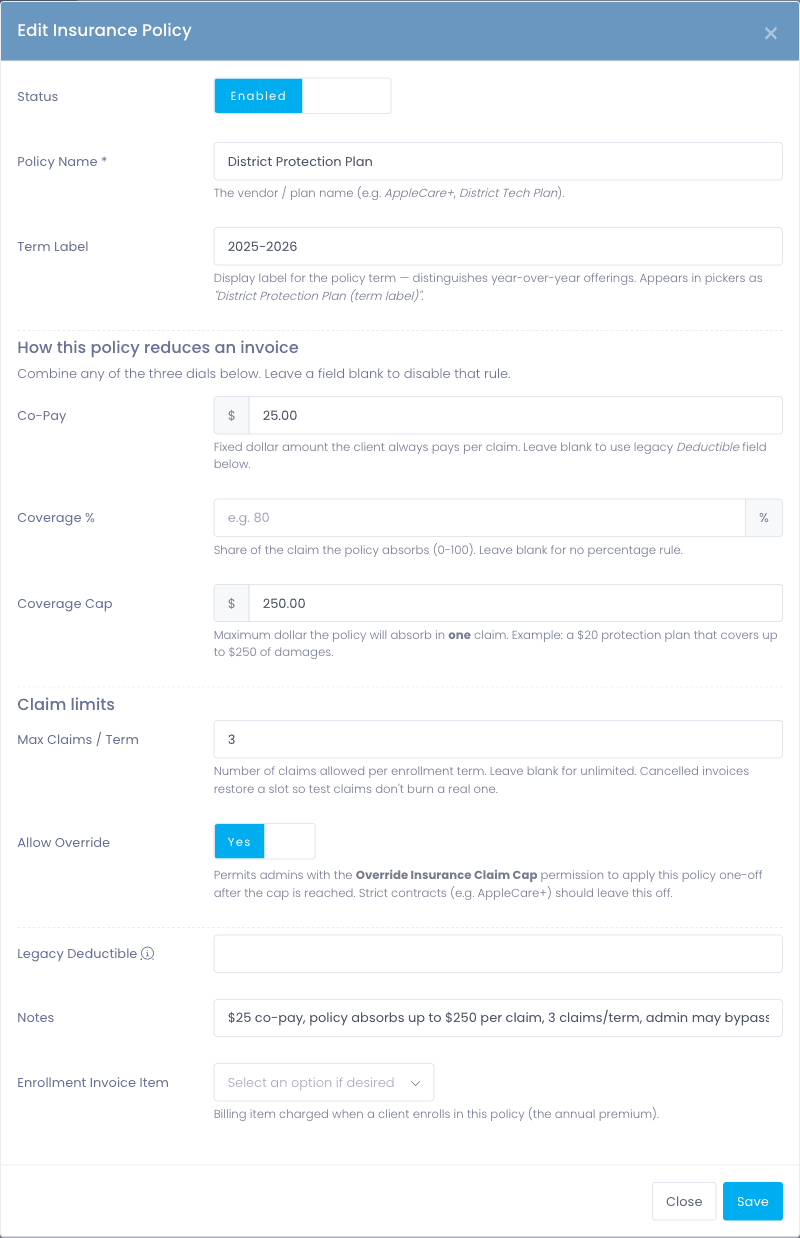
- 2Step 2 of 6
Students are enrolled on arrival, not chased afterwards
A district can auto-assess a default policy the moment a student is added, so nobody is quietly running uncovered because their enrollment landed in the gap between the start of term and whenever the office got to the paperwork. Assigning the policy raises the premium at the same time, which keeps the coverage record and the money in the same place from the start.
- A default policy can be assessed automatically when a student is added
- Assigning insurance creates the payable premium in the same action
- The premium is due a configurable number of days out, thirty by default
Manage1to1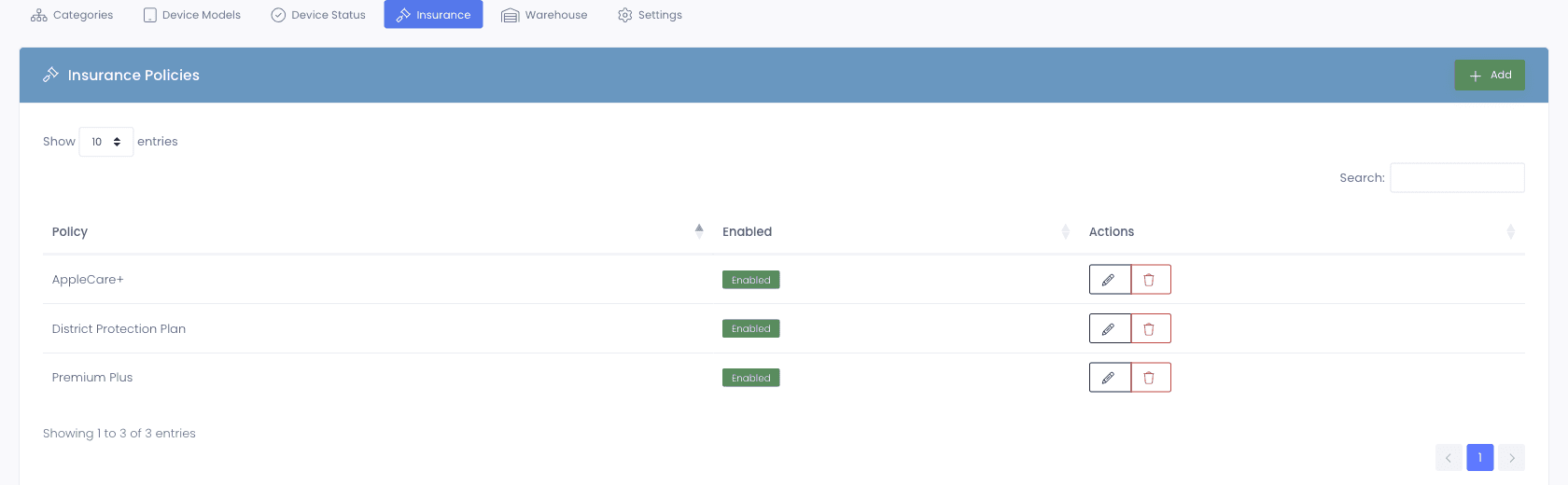
- 3Step 3 of 6
Families who qualify are never charged in the first place
The common approaches to fee equity both leak. Billing everyone and refunding later means a family on free and reduced lunch still gets an invoice they cannot pay, and refunds depend on somebody processing them. Asking the front office to remember who to skip depends on that person being there. The waiver applies before the charge exists, driven by eligibility rather than recollection.
- The waiver happens before the invoice is raised, not as a refund afterwards
- Eligibility can arrive from your SIS through OneRoster metadata mapping and stay current with the nightly sync
- No family receives a bill that somebody then has to reverse
- 4Step 4 of 6
An unpaid premium ends the coverage, on its own
This is the step that decides whether the program breaks even. If a premium goes unpaid and coverage silently continues, the district is underwriting repairs it was never funded for, and nobody notices until the year is costed. A premium still unpaid past its window auto-cancels on a daily run and the coverage ends with it, so the billing state and the coverage state never disagree.
- Unpaid premiums past the window cancel automatically on a daily run
- Coverage ends at the same moment, so nothing sits half-paid and half-covered
- The answer to who is covered today is a fact in the system rather than an assumption
- 5Step 5 of 6
When damage happens, coverage is read as of that date
A claim is assessed against what the student had on the day the device broke, not on the day somebody processes the paperwork. That distinction decides real money: a policy that lapsed in February does not cover a January incident, and one that was active in January still does even if the claim is filed in March. Manufacturer warranty and AppleCare are held separately from the district plan, with claims already used against the term visible on the record.
- Insurance status and coverage on the incident date are both shown on the incident
- Claims already used this term are visible, so a cap is enforced rather than remembered
- Warranty and AppleCare stay distinct from the district plan rather than collapsing into one field
Manage1to1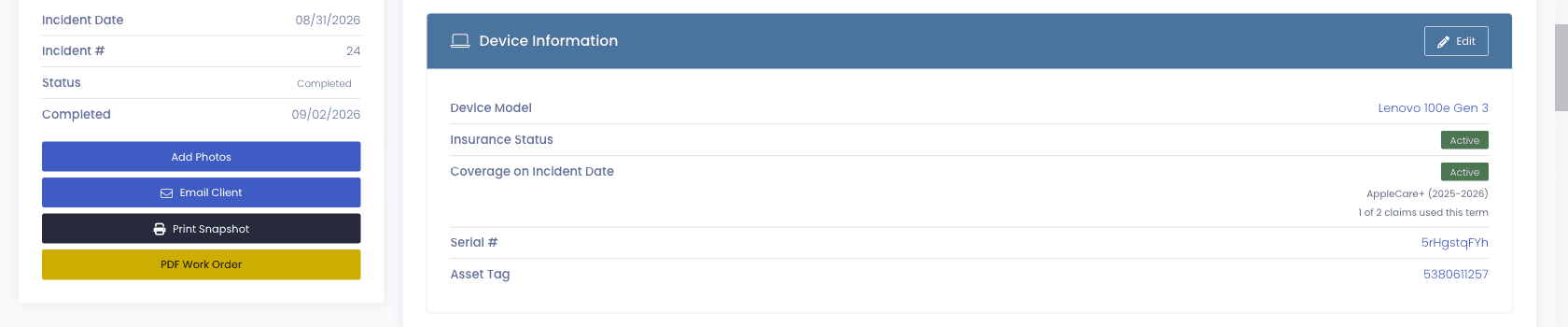
- 6Step 6 of 6
The split is calculated, and what remains becomes an invoice
Applying the policy walks its own rules and produces two numbers: what the plan absorbs and what the family owes. Both are recorded against the incident, so the calculation can be explained to a parent in November or an auditor in June without anyone reconstructing it. The family portion becomes an invoice from the incident that created it.
- Co-pay, percentage, and ceiling applied from the policy rather than by hand
- Both figures recorded on the incident, so the arithmetic is auditable later
- The family portion becomes an invoice traceable back to the damage that caused it
Manage1to1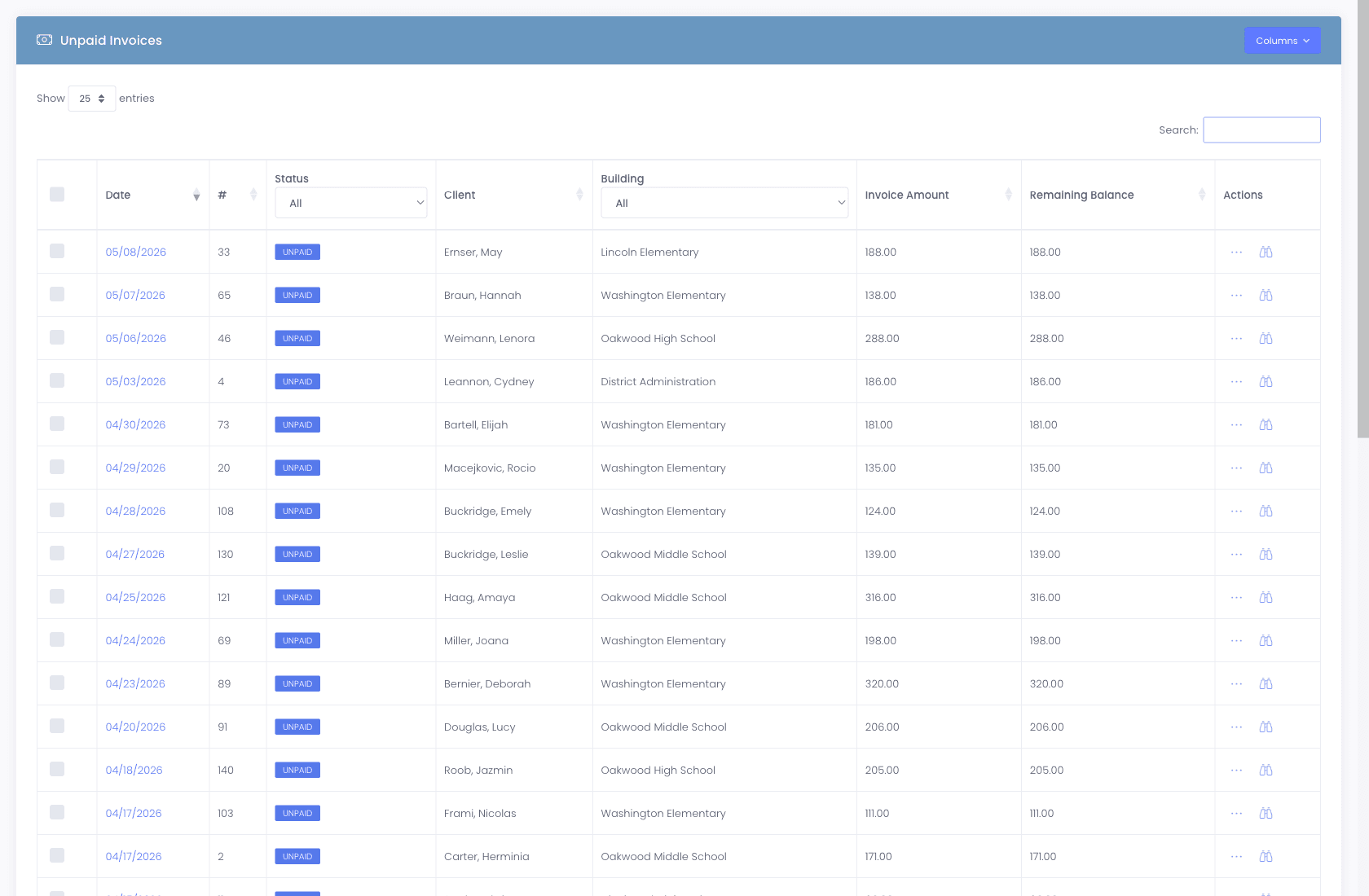
What changes
Every family treated the same way, and the program pays for itself.
A protection plan only works if the rules are applied consistently by the system rather than reconstructed by whoever is on duty. That consistency is also what makes the program defensible when a parent asks why they were charged and a colleague was not.
- Who is covered today is a fact, not an assumption based on who paid at some point
- The district stops absorbing repairs for coverage that was never actually funded
- Free and reduced families never receive a bill that has to be reversed
- A claim cap is enforced by the record rather than by a technician remembering
- Two families with identical damage get identical treatment, and you can show why
The capabilities behind this
FAQ
Common questions.
- A district defines a policy with four variables: a co-pay the family owes regardless of repair cost, the percentage of the cost the plan absorbs, a ceiling on what it absorbs per incident, and how many claims are allowed in a term. Students are enrolled and a premium is raised. When a device is damaged, coverage is checked as of the incident date, the policy rules produce the split between what the plan pays and what the family owes, and the family portion becomes an invoice.
- A premium still unpaid past its window cancels automatically on a daily run, and the coverage ends at the same time. This matters more than it sounds. If coverage continues while the premium goes uncollected, the district is underwriting repairs it was never funded for, and that usually goes unnoticed until the year is costed.
- The waiver applies before the charge exists rather than as a refund afterwards. Billing everyone and refunding later still puts an invoice in front of a family that cannot pay it, and depends on somebody processing the reversal. Eligibility can come from your SIS through OneRoster metadata mapping, so the status stays current with the nightly sync instead of living on a separate list.
- Yes. Max claims per term is part of the policy, with an unlimited option if you would rather not cap it. Claims already used against the current term are visible on the record, so the limit is enforced by what the system knows rather than by whether a technician remembers this student has been here before.
- No, and treating them as one field is the most common way districts lose money on this. Manufacturer warranty, AppleCare, and a district protection plan have different terms, different durations, and different claim rules. They are held as separate records, so a repair already covered by the manufacturer is not charged against the district plan or billed to the family.
Price your own plan
See what your protection plan looks like with real rules.
Tell us your co-pay, coverage percentage, and claim limit and we will set it up in a demo so you can watch a claim run through it. Our team is entirely former K-12 IT, several of us have administered these plans, and we will tell you if your numbers will not cover your breakage rate.